

Why a Perfect Sample Still Fails on the Body
Two jackets can be cut from the same pattern and the same colour card and still behave like different products. One falls from the shoulder and moves with the arm; the other stands away at the front, marks at the elbow within an hour, and shows a pale line where the sleeve was pressed. The difference is not the pattern. It is the cloth underneath the coating.
This note treats synthetic leather fabric for apparel as a clothing material rather than a catalogue item: how it hangs, how it returns after folding, what it does at a stitch line, and what heat leaves behind. The measurements that belong on paper are at the end.
Before you read on: a coated cloth has two parts. The PU surface provides colour and touch; the backing provides body and movement. A quotation that describes only the surface has described half a material.
Short answer: the how the cloth behaves of synthetic leather fabric for apparel comes from its backing, not its coating. Hang, fold recovery, stitch response and heat response are the four things a sampling bench can judge in an afternoon - and the four that decide whether production matches the sample.
In brief:
- A knit web moves with the arm; a bonded web holds a line.
- Crush a corner for ten seconds - the way back matters more than the touch.
- Overlaps multiply the PU layer, so curves need allowance and a light hand.
Two Layers, Two Jobs
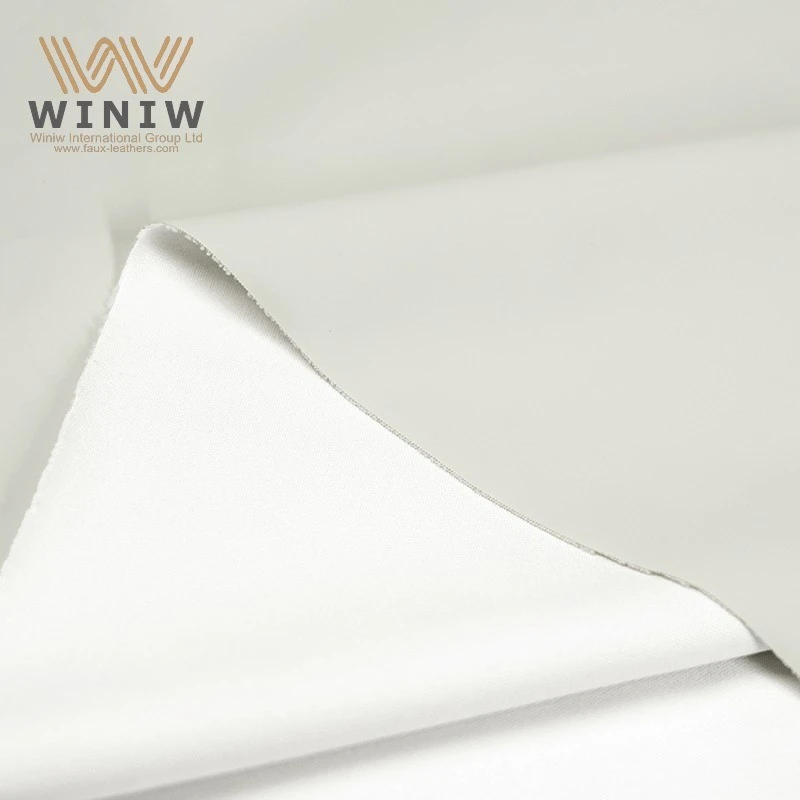
The face is polyurethane: pigment, surface, sheen, and the way dirt sits on it. The back is a textile web - knit or non-woven - and it governs almost everything a wearer feels. A knit web lets a sleeve travel with the arm and spring back afterwards. A bonded non-woven web holds a panel flat, keeps a cut edge tidy and gives a coat its line.
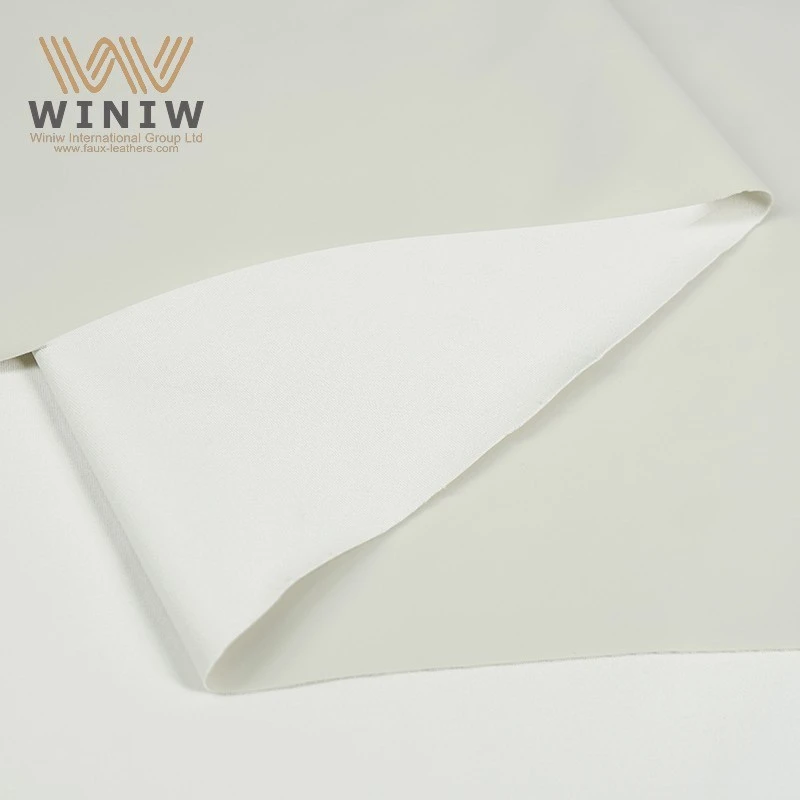
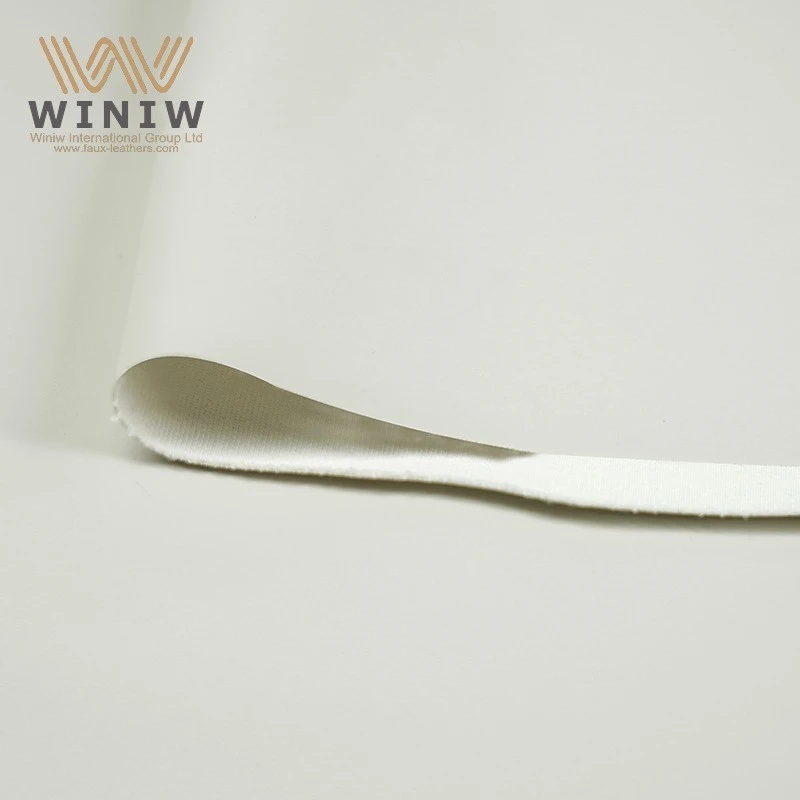
The cream cloth in these photographs is a PU surface on a fibrous bonded web, 137 cm (54 in) across the usable width, with colour and surface developed against a customer's master. It is sold by the roll for cut-and-sew work, so what counts here is how it behaves on a cutting table and on a body, in that order.
That split also explains a common misunderstanding in sampling: the buyer reads the face, the pattern cutter judges the back with two fingers. If only one of them has approved it, the two descriptions of the same roll will not match.
On the Body: Hang, Return, Fold Marks
How it hangs
Hang is the shape cloth takes under its own weight. Hold a metre over the table edge and watch where the bend lands: close to the edge means it will follow a body; pushing outward means it is carrying itself and will read as outerwear. Record the result as a kept piece, because "soft" describes a hundred different cloths.
How it returns
Grip a corner for ten seconds, let go, and look. Cloth that flattens again keeps a jacket looking crisp through a shift; cloth that keeps the mark looks tired by mid-morning and worse after cleaning. Return is built into the web, so it is fixed before dyeing - it cannot be added at finishing.
Where clothing actually folds
Elbows, seat, hem, the front of a skirt. A roll can be flawless on a hanger and still mark at those four places after an hour of wear. A lab result will not answer this; a worn sleeve will. Sew one, wear it for a day, photograph the bends. That photograph outranks any adjective on an order sheet.
At the Machine: Seams, Heat, Pressing
Seam bulk
Coated cloth does not squash the way a woven does. At a join the PU layer meets itself, and on a curve that surplus has to go somewhere: it puckers, ripples, or leaves a bright line where the foot has flattened the surface. A narrower allowance and a clipped curve usually do more than a heavier needle.
Needle heat
A needle running at speed gets warm, and a thermoplastic face reacts to warmth. The result is a row of small shiny dots along the stitch line that no amount of pressing removes. Slower running, a fresh needle and a longer stitch are the usual answers - and the trial belongs on your own machine, not the sampling bench's.
Pressing and bonding
Heat and pressure change a face that looked right on a hanger. Press an offcut before a jacket: low temperature, a barrier cloth, short dwell. If fusible interlining is part of the make-up, test the pair together, because adhesive and PU can react in ways neither shows alone.
Linings, Interlinings and the Layers Underneath
A coated outer layer is only half of a jacket. What sits behind it decides how the whole assembly behaves: a slippery woven lining lets the shell slide over a sweater, a brushed lining adds warmth and friction, and a fusible interlining stiffens a placket that would otherwise sag.
Two practical notes. First, match the weight of the lining to the shell, not to the season: a heavy lining under a soft shell drags the whole garment down at the shoulder seam. Second, bond a sample of shell plus interlining before cutting a full panel. Adhesive softening points vary, and a bond that looks clean on a flat bed can strike through on a curved front.
None of this alters the outer cloth, but it decides whether synthetic leather fabric for apparel reads as a jacket or as a costume. For skirts and trousers the same logic applies with less tolerance: a stiff interlining at a waistband will show through the shell after a few wears, and a waistband facing cut from the shell itself tends to curl unless it is fused and pressed on a curved form.
Trims deserve the same trial. Metal zips pull at a coated edge, so a tape or a facing behind the zip saves a tear later; plastic teeth are lighter but can abrade a soft face at the slider; buttons sit better on a reinforced facing than directly on the cloth. Thread matters too: a bonded polyester thread holds a seam on a coated surface better than a soft cotton, which tends to fray at the needle.
What Belongs on Paper
Five lines cover most of what a cutting room needs, and every one of them can be checked against a physical piece rather than a sentence.
| Point | This cloth | What to pin down |
| Build | PU face, bonded fibrous backing | Knit or non-woven, and which one was quoted |
| Usable width | 137 cm / 54 in | The trimmed number, per delivery |
| Substance | Confirmed per order | The number your pattern was cut to |
| Shade | Cream / ivory in stock; custom to master | Light source and the tolerance across a run |
A Production Story
⚠️ Composite example drawn from common buyer situations, not a named customer; no numbers are attached.
A small label signs off a cream swatch of synthetic leather fabric for apparel for a spring bomber. The prototype is right. The production run arrives and the sleeves feel stiffer, the fronts shine after pressing, and two sizes pucker at the armhole.
No roll was defective. The backing had been switched, the press had been set for a different cloth, and the seam allowance had come across from a woven pattern. A crush test, a press test on an offcut and one sleeve sewn on the real machine would have caught all three before cutting. The cost of those tests is a few metres; the cost of skipping them is a size run.
Storage Between Delivery and Cutting
Rolls arrive wound on a core and are usually opened days before cutting. Stand them upright rather than stacking them flat, keep them off a concrete floor, and leave a roll to relax for a day before it goes on the table - a cloth that has been compressed in transit will spring once it is unrolled, and a marker cut on the first morning can be short by the second.
Heat is the other quiet risk. A store room beside a boiler or under a skylight will soften a thermoplastic face just enough to pick up the texture of whatever it leans against. If a roll has to wait weeks, keep it wrapped, keep it level, and keep it out of direct sun.
Four Checks Before Cutting
- Keep an approved piece. One per colour, dated, compared under the lamp used on the line.
- Check both ends of every roll. Marks, joins and edge damage hide at the head and tail.
- Sew and press one sample on your own equipment. Then write the settings at the station.
Who Wrote This
WINIW has made synthetic leather for 25+ years; clothing is one of the programmes we quote weekly. The photographs here are our own cloth, not a stock image, and the numbers we publish are the ones we can stand behind.
That is why some cells above say "confirmed per order": we would rather agree a number with you than print a catalogue value nobody has measured.
Questions We Get From Garment Teams
Is it warm enough for a jacket shell?
As a shell, yes - it blocks wind and holds a line. Warmth comes from what you line it with, not from the coated cloth itself. Treat the face as the outer layer and plan insulation separately.
Will it stretch enough for a fitted sleeve?
Only if the backing is a knit. Bonded non-woven gives very little, and no finishing step will add it. If the block needs movement, say so when the swatch is requested.
Can a garment be pressed after making up?
With a barrier cloth, low heat and a short dwell, and only after an offcut has shown what the surface does. A thermoplastic face has a memory: once a shine is pressed in, it stays.
What does "REACH compliant" mean here?
It describes a screening, not a badge. Our report (Intertek SZHH01505701) covers a material sample checked against the ECHA candidate list, where disclosure starts at 0.1% by weight; it says nothing about a finished jacket, its interlining or its buttons.
Tell us the colour master and the end use, and we will cut A4 or A3 pieces in the backing that suits the garment: knit for movement, bonded web for structure. Swatches are free; freight is collect.
Related Reading
|
Working on a different end use? Browse the synthetic leather fabric range, or ask for a swatch. |


