

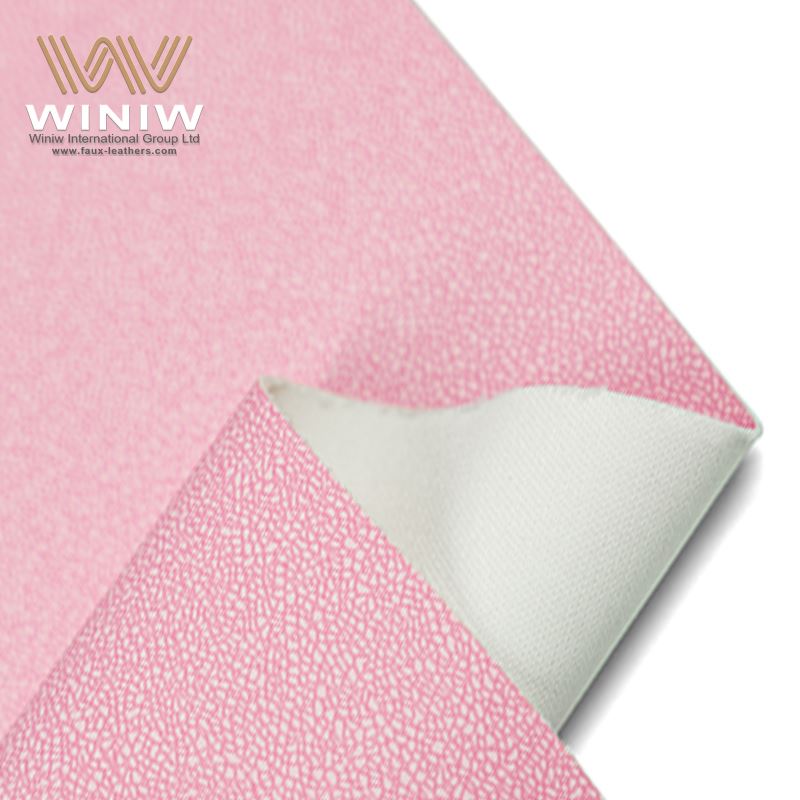

A jewelry display stand is judged from arm's length under a shop lamp, then handled all day by staff. This page is for the buyer who has to cover a neck bust, a ring tray and a tiered riser from one sheet - and keep all three reading as one set after the second reorder.
|
0.4 / 0.5 / 0.6 mmgauge on the roll
|
1370 mmusable width, 54 inch
|
300 mrun per colour
|
1 platefine pebble, matte face
|

Specification, before anything is cut
|
Point
|
Mill supplies
|
Stand maker confirms
|
|
Face colour
|
Rose pink as photographed, or dyed to a signed chip
|
a chip under the counter lamp, not a screen colour
|
|
Thickness (mm)
|
0.4 / 0.5 / 0.6 mm
|
the tightest radius the stand has to turn
|
|
Width
|
1370 mm (54 inch)
|
how many faces you get per metre
|
|
Material, backing
|
PU coating on microfibre or non-woven
|
adhesive family, and whether the edge is turned
|
|
MOQ, run length
|
300 linear metres per colour
|
whether a trial run comes before the full order
|
|
Paper trail
|
REACH SVHC, Intertek SZHH01505701
|
whose file the report is addressed to
|
Turning one sheet into tray, riser and bust
Three shapes decide the order, and each one fails differently on the bench:
- Tray and pad: flat, glued underside-down over board. 0.4 mm is enough where the tray sits inside a case; 0.5 mm reads better where a customer lifts it.
- Riser and step: wrapped over an edge. Ask for 0.5 mm unless the radius is tight, then 0.4 mm turns it without a pale line at the fold.
- Neck bust and ring finger: a curve plus a narrow strip. 0.4 mm follows the curve; 0.6 mm is for a large flat lid that must not dish between supports.
Two bench habits save most of the rework. Sand the board edge flat before wrapping, or a thin sheet telegraphs the seam. And glue the underside, never the face - an adhesive line shows through a matte finish long before it shows on a gloss one.

The cutting plan decides the yield
A 1370 mm roll is generous until the nesting starts. Two tray faces and one riser strip normally sit side by side; add a bust strip and the plan has to turn, which leaves an offcut too narrow for anything but a pad. Draw the nesting before the order is placed, not after the first roll is opened.
The same plan sets the template. Cut a hardboard template for each shape once, mark the grain direction on it, and every panel in the set comes out with the pebble running the same way. Without that mark, a tray and its riser catch the lamp at different angles, which is what makes a matched set look mixed.
Keep the waste visible. A guillotine cut on a matte face leaves a slightly lighter edge, and that edge belongs at the back of a tray, not on the front lip where a customer's thumb lands first.
Shade control from counter to reorder
Colour trouble on a display stand happens in public: the bust in the window is a tone off the tray beside it. The controls are procedural, not heroic. Cut every panel of one set from one roll sequence. Keep the signed chip on the bench while panels are checked, not filed in an office. Write the batch number on the order so a reorder can be run against it instead of against a photograph.
The coating is applied, dried and wound on our own lines, and rolls are checked against the approved chip before packing. We run multiple production facilities in Jinjiang, have supplied synthetic leather for more than 25 years, and ship about one million metres a month across footwear, bags, upholstery, garments and packaging.


Four stand forms this sheet covers
Necklace bust. A narrow cone with a steep shoulder. Cut a two-piece gore rather than stretching one strip around the crown; at 0.4 mm the seam closes under a light rub and the shoulder keeps its pebble.
Ring tower and finger cones. Small, repetitive, and the part that shows handling first. Cut from the same roll sequence as the tray so a customer comparing two towers does not see two pinks.
Earring card stand. A flat face with a slot. The sheet has to sit dead flat under the cards, so glue it over a sanded board and press from the slot outwards, not from the edge inwards.
Tiered riser. Three or four boxes stacked, each wrapped separately. 0.5 mm turns the top edges without bulging at the corner; a thicker sheet squares the corner but shows the wrap on the front face.
No certificate is issued to a finished stand here: the one report we hold, REACH SVHC at material level, speaks about the sheet. Light fastness, abrasion cycles and grammage are absent for this grade, and naming the test your buyer wants is the way to get a number that holds.
Buyer questions
Where can I find wholesale jewelry displays?
Wholesale display supply splits in two: the finished stand from a display maker, and the covering sheet from a leather mill. Most stand makers buy by the roll and finish the board themselves, which is why a 300 metre run per colour usually covers a whole range rather than a single stand.
Where can I buy jewelry display trays wholesale?
Trays are normally the first part of a range to be ordered, because they are the cheapest to change. Work out the nesting across 1370 mm before you commit: that decides whether the minimum run lands on one colour or has to be split.
How to display jewelry in a boutique?
Height first, then colour. A boutique reads best when trays stay low and the busts carry the light, so the eye travels up rather than across. Keep one pebble across every level and let the shade change by zone instead of by object - dark risers under white metal, pale trays under coloured stone.
How to make a display for jewelry?
Cut board to the silhouette first, then cover it: glue the underside, press from the centre out, and turn the edge before the adhesive grabs. Sand the board edge so a 0.4 mm sheet does not telegraph the seam. A spray adhesive is quicker but creeps in a warm window; a water-based contact glue holds a turned edge better.
Which gauge should a covered stand use?
On this sheet: 0.4 mm for a tight curve or a small pad, 0.5 mm as the general choice, 0.6 mm where a large lid needs body. Send the smallest radius on the stand and the board thickness, and the choice stops being a guess.
Send a stand drawing, get a swatch
Tell us the smallest radius, the board you glue to and the shade you are building around. We reply with the gauge per part, the nesting across 1370 mm and a physical swatch, freight collect.
Request Material Sample
Hot Tags: rose pink pu leather for jewelry display stands: cutting and yield, China rose pink pu leather for jewelry display stands: cutting and yield manufacturers, suppliers, factory, 0 5mm Water And Stain Resistance Polyurethane Pu Leather for Business Gift Box, DMF Free Synthetic Garment PU Leather 0 5mm 0 6mm 0 7mm Thickness for Jackets, Embossed PU Crocodile Leather 1 2mm Thickness PU Faux Leather Fabric Waterproof, Faux Leather Material Polyurethane Fabric Leather for Labels, High End Comfortable Vegan Faux Leather PU Imitation Leather for Labels, Long Lasting And Fashionable PU Vinyl Synthetic Leather Bag Materials


